

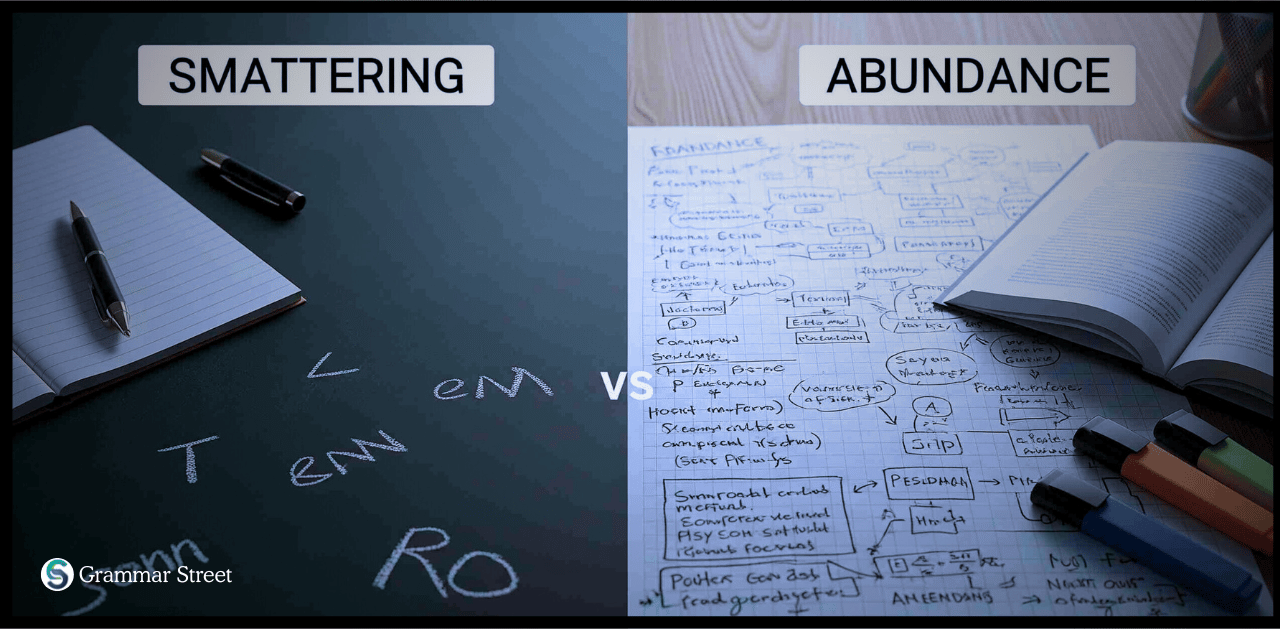
Have you ever come across the word smattering and wondered what its opposite might be? Maybe you’re trying to describe someone with extensive knowledge or deep understanding of a subject, but you’re unsure of the precise term to use. If so, you’re in the right place! Today, I’ll walk you through everything you need to know about the opposite of smattering, helping you build a stronger vocabulary and a clearer understanding of how to express depth versus superficial knowledge.
What Is Smattering, and Why Understand Its Opposite?
When we talk about smattering, we’re referring to a small amount of knowledge or a superficial understanding of a topic. For example, having a smattering of French means you know the basics but aren’t fluent or deeply knowledgeable.
Understanding its opposite is vital because it allows you to describe someone with comprehensive knowledge, mastery, or expertise instead of just a little familiarity. Knowing this can elevate your language, especially in academic, professional, or conversational settings.
Defining the Opposite of Smattering
Let’s first clarify what the opposite of smattering is, with some detailed explanations and definitions:
| Term | Definition | Example Usage |
|---|---|---|
| Proficiency | The state of being skilled or competent in a particular area. | “She has proficiency in computer programming, having worked in the field for over a decade.” |
| Mastery | Complete and authoritative command of a subject or skill. | “His mastery of classical piano is evident in every performance.” |
| Expertise | Specialized skill or knowledge in a particular domain. | “The researcher’s expertise in microbiology is unmatched.” |
| Comprehension | Deep understanding of a concept or subject. | “Her comprehension of quantum physics amazes her peers.” |
| Breadth of knowledge | Extensive knowledge covering many aspects of a topic. | “He possesses a wide breadth of knowledge in history.” |
Key Differences Between Smattering and Its Opposite
| Aspect | Smattering | Opposite (Proficiency, Mastery, Expertise) |
|---|---|---|
| Depth of knowledge | Superficial | Deep and thorough |
| Confidence in subject | Limited | Confident and assured |
| Usage context | Casual mention, brief understanding | Advanced, professional, instructional |
| Examples | “I have a smattering of the language” | “She has mastery in the language” |
How to Describe the Opposite of Smattering Effectively
When articulating a profound understanding or skill, consider these steps:
- Use precise adjectives: proficient, expert, knowledgeable, skilled.
- Pair with nouns that denote mastery: knowledge, skill, ability, competence.
- Provide examples to showcase depth, such as certifications or years of experience.
Example Sentences:
- He demonstrated exceptional proficiency in quantum mechanics during the seminar.
- Her mastery of culinary arts allows her to create dishes that delight every palate.
- The engineer’s expertise in software development led to the successful launch of the application.
- After years of study, she gained a deep comprehension of classical literature.
Important Tips for Expressing Deep Knowledge
- Use quantifiable indicators: years of experience, certifications, published works.
- Combine multiple descriptors for clarity: highly skilled, deeply knowledgeable, extensively trained.
- Avoid overuse of vague words like “good at”; be specific.
Common Mistakes and How to Avoid Them
| Mistake | Explanation | How to Avoid |
|---|---|---|
| Using “smattering” when meaning mastery | Confusing superficial knowledge with deep expertise | Choose precise words like proficiency or expertise. |
| Overgeneralizing | Saying “knows a lot” without context | Provide examples or specific skills. |
| Mixing levels | Combining basic and advanced skills improperly | Break down skills and state levels clearly. |
Variations and Synonyms of the Opposite of Smattering
Here are several terms that can be used interchangeably based on context:
- Adept
- Skillful
- Experienced
- Well-versed
- Competent
- Veteran
- Qualified
- Practiced
- Masterful
- Savvy
Example Sentences:
- She is an adept programmer with numerous successful projects.
- He is well-versed in financial analysis.
Why Is Using the Opposite of Smattering Important?
Knowing and accurately expressing someone’s deep knowledge matters, especially in:
- Hiring situations
- Academic discussions
- Professional evaluations
- Personal development
Using the right words boosts your credibility and helps you communicate your message clearly. For instance, saying “I have a smattering of Spanish” sets a different expectation than “I am fluent in Spanish.” Precision matters.
Categories Where the Opposite of Smattering Applies
Here are 15 meaningful categories illustrating the breadth of application:
| Category | Example Description | Example Sentence |
|---|---|---|
| Personality Traits | Confident, knowledgeable individual | “He’s an expert in negotiation skill.” |
| Physical Descriptions | Skilled athlete | “She is a master swimmer, setting national records.” |
| Roles | Professional, specialist | “He’s a seasoned engineer on the project team.” |
| Academic Knowledge | Deep subject comprehension | “Her expertise in chemistry has led to groundbreaking research.” |
| Artistic Skills | Master artist | “The painter’s mastery of color blending is unmatched.” |
| Leadership | Skilled leader | “She’s a proficient manager with excellent team skills.” |
| Technical Skills | Advanced programming | “His mastery of AI algorithms is impressive.” |
| Customer Service | Expert at problem-solving | “She’s highly skilled at handling customer complaints effectively.” |
| Writing | Accomplished author | “He’s a veteran writer with numerous bestsellers.” |
| Business | Experienced entrepreneur | “Their proficiency in market analysis drove the startup’s success.” |
| Languages | Fluent speaker | “She’s well-versed in French and Italian.” |
| Sports | Elite athlete | “The boxer’s mastery of his craft is evident in his knockout power.” |
| Science | Groundbreaking researcher | “Her expertise in molecular biology earned her a prestigious award.” |
| Music | Skilled musician | “His mastery of the violin is captivating.” |
| Cooking | Culinary expert | “The chef demonstrated his proficiency with French cuisine.” |
Practice Exercises to Reinforce Your Learning
1. Fill-in-the-Blank
Choose the correct word: proficient, smattering, amateur, expert.
- After five years of training, she became highly __________ in digital marketing.
- He only has a __________ of knowledge about astrophysics, so he doesn’t speak on the topic confidently.
- That new chef is __________ at making pastries.
- You can’t call a beginner an __________ in computer coding.
2. Error Correction
Identify and correct the mistake:
- “He only has a smattering of knowledge in medicine but claims to be a doctor.”
- Corrected: __________________________________________
3. Identification
Read the sentence and identify if it shows superficial or deep knowledge:
- “She has an extensive understanding of Renaissance art and has published several papers.”
Answer: _______________________________
4. Sentence Construction
Create a sentence using the phrase deep mastery of a skill or subject.
5. Category Matching
Match the description to the correct term:
- Deep understanding and practice — __________
- Superficial knowledge — __________
- Knowledge from experience — __________
Answers:
- Mastery
- Smattering
- Skilled
Summary & Action Points
So, today, we explored the opposite of smattering—words like mastery, proficiency, expertise—all highlighting deep, comprehensive knowledge. Remember, choosing the right word depends on context: are you describing superficial familiarity or professional mastery? Use precise language to make your communication clear and impactful.
Action Point: Next time you describe someone’s skills or knowledge level, challenge yourself to pick the most accurate term. It will enrich your vocabulary and boost your confidence in expressing competence!
In conclusion, knowing the opposite of smattering opens the door to more precise, powerful language. Whether talking about someone’s mastery or a professional’s expertise, the right words make all the difference. Keep practicing, and your language skills will soon mirror the depth of your knowledge!
